Showing posts with label Clothing. Show all posts

Monday, August 15, 2016

Breezy Net Repeating Lace Pattern

Recently I knew I wanted to make a stole out of a lace weight yarn (in this case, Artyarns' Silk Mohair Glitter in color H12). I wanted a really simple, open lace pattern with lots of space between the threads, almost like a fisherman's net. But I couldn't find a lace pattern that was open enough without being way too overwrought for me. So I made up my own pattern.

Breezy Net Lace
When repeated, this pattern does not increase or decrease stitches, so it is good for a square object such as a scarf.

This pattern is a multiple of 6 stitches plus 4; the plus-4 is for two garter stitches at the edges of the piece, but you could of course have as many or as few garter stitches as you wanted. It is a four-row repeat.

Breezy Net Repeating Lace Pattern
Start by casting on as many stitches as you need for the width of your piece size as if you were knitting it in garter stitch.

This version of the pattern includes two garter stitches on either edge of the piece.

1st round:  K2, *yo, k3tog, yo, k3, repeat from * to last 2 sts, k2.

2nd round:  K2, k2, k2tog, yo, k1, yo, *k2tog, k1, k2tog, yo, k1, yo, repeat from * to last 9 sts, k2tog, k1, k2tog, yo, k2, k2.

3rd round:  K2, *k3, yo, k3tog, yo, repeat to last 2 sts, k2.

4th round:  K2, k2, yo, *k2tog, k1, k2tog, yo, k1, yo, repeat to last 6 sts, k2tog, k2, k2.

The stole, partially stretched to show
lace pattern.
The pattern from a little farther away.

Monday, July 11, 2016

Victor Op-Art Socks

Dimensions: Fits men's U.S. shoe sizes 9-10
Completed: January 2016
Vega-Nor by Victor Vasarely (1969)

I made these socks using the pattern called "Victor" in Op-Art Socks by Stephanie van der Linden. (This is the same book I used to make the Symmetry socks in 2015.) These socks are based on the art of Victor Vasarely, who liked to use optical illusions in his artwork.

As with the Symmetry socks, I substituted Lorna's Laces Shepherd Sock hand-dyed yarn for the pattern's original Zitron Trekking Sport 4-ply yarn. I used 2 skeins each of #511 Buckingham Fountain for the variegated khaki, and #4ns Blackberry for the purple. I knitted these on a US #1 needle.

To avoid the problem I ran into with the Symmetry socks, where one of them ended up slightly larger than the other, I knitted these socks simultaneously on a 36" circular needle.

This pattern involved a lot of complex chart-following two-color knitting. And I'm not that skilled when it comes to keeping my gauge correct in two-color knitting; I tend to make it far too tight. I tried to remain loose with these socks, and to catch my floats using this method whenever I had done three stitches of the same color. The socks still came out a little tighter than I had planned, but they are wearable.


They look great from the top...


...and the heel is cool, too.
Socks at rest.

Monday, June 13, 2016

Karen Q's Uluru Scarf

Dimensions: 6' by 8" wide (with 3" fringe on each end)
Completed: November 2014

The warp is one skein of Knitting Fever Uluru (cotton, acrylic, polyester) in color #11 Ammonite. The weft is one pick of the Uluru alternating with two picks of Classic Elite Vail (baby alpaca and bamboo viscose) in color #6436 Sand. I only needed one skein each of the Uluru and the Vail. The Vail gave the scarf have a really nice soft texture.

Scarf on the loom
I originally started by using only the Vail for the weft, but it was just making the scarf come out looking too white. So I ripped out the two inches or so I had already done, and started over again alternating two picks of the Vail with one pick of the Uluru. I think it turned out to be a very nice subtle effect for the color.

This is all done in plain weave -- nothing fancy, like the two tweed scarves I made earlier in 2014. I guess I needed a break!


Monday, May 16, 2016

Luigi's Locks Grass-Green Bouclé Scarf

Dimensions: 8" wide by 72" long, plus 4" fringe at each end
Completed: February 2016
The raw material

I wove this scarf in a straightforward plain weave on my rigid heddle loom. I didn't think it was worth trying to do anything fancy with the weave because I thought the bouclé structure of the yarn would probably obliterate any pattern I attempted. And, more importantly, the yarn was so beautiful I really wanted it to be the focus here, not the weave.
 
The warp and weft are both done in the same yarn: a hand-dyed grass-green bouclé mohair yarn called "Luigi's Locks" from Yellow Dog Farm, which I bought at the Vermont Sheep and Woolcraft Fair last summer. The yarn has little streaks of darker green and lighter yellow-green throughout.

A sample I wove on a piece
of cardboard to see if the 7.5 epi
gauge would look all right
Luigi's Locks
on the loom


This scarf probably used about 400-425 yards of wool; I had two skeins of 225 yards each, and I ended up using roughly one and two-thirds of the skeins.

When I measured its gauge, it looked like Luigi's Locks was roughly a worsted weight  I used a 7.5 dent reed and tried to keep to roughly 7.5 ppi so that it could be a pretty loose, open weave; I did this both so the fabric wouldn't be so stiff, and also so there would be plenty of room for the little bouclé loops to poke out in all directions. I warped the loom with 62 ends of 8.5 yards each.

The scarf was about 8.25" wide on the loom, and about 8" off the loom. I wove the scarf out to about 74" long, which only ended up shrinking a tiny bit to about 72" long off the loom; maybe the bouclé loops helped it keep its size off the loom. I left 4" of fringe on both ends, which I tied off in groups of four warps each.

The final product (although this is
not what the color really looks like)
Close-up of the finished fabric


Monday, March 14, 2016

Leno & Brooks Bouquet Scarf in Serenity Glitter Sock Yarn

Dimensions: 8" wide by 63" long, plus 3" of fringe on both ends
Completed: November 2015
 
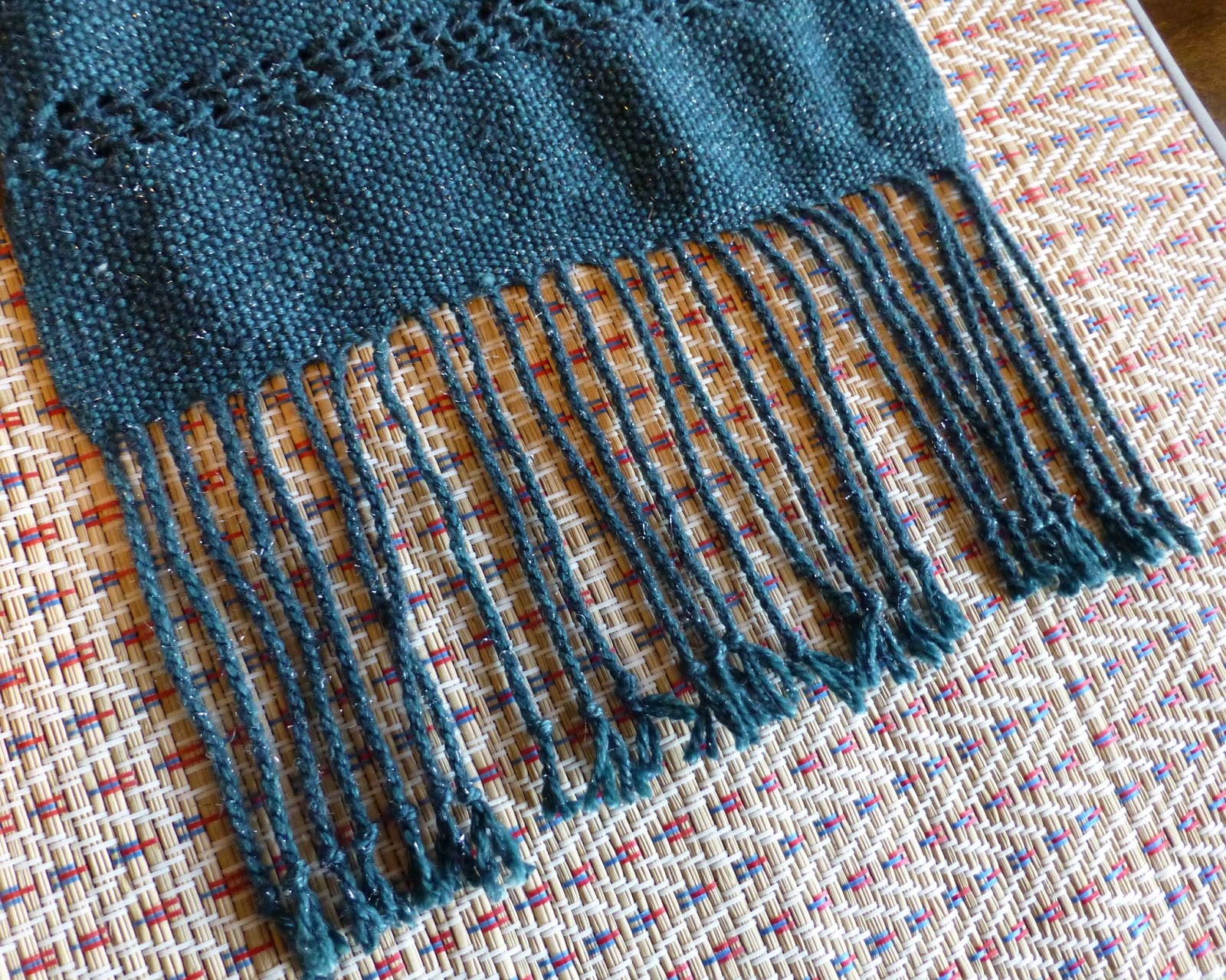
This summer I made my first-ever in-person trip to the Webs yarn store in Northampton, MA, where I bought two skeins of Zen Yarn Garden's superwash merino Serenity Glitter Sock yarn in Midnight Teal. It is a beautiful dark, dark blue-green color with little bits of silver glitter spun into it.
 
Working the pick for a row of leno
I've read a number of blog posts recently that urged me to try making a woven scarf out of sock yarn, and I'd been meaning to learn how to do some hand-picked openwork weaving on my rigid-heddle loom, so I thought the combination might be perfect for this yarn.
 
I warped my loom with 104 ends 90" long (leaving about 18" for loom waste). I set it up for plain weave using a 10 dent heddle. It was about 10 1/2" wide in the loom, but it shrank down to about 8" when I took it off the loom.
 
Once the loom was set up, I wove using this pattern:
 
- 36 picks of plain weave
- 1 row of 2:2 leno with an open shed, starting by twisting two warps over two warps
- 1 row of 2:2 leno with an open shed, starting by twisting one warp over one warp
- 20 picks of plain weave
- 1 row of Brooks bouquet where each bouquet went over four warp ends
- 20 picks of plain weave
- 1 row of 2:2 leno with an open shed, starting by twisting one warp over one warp
- 1 row of 2:2 leno with an open shed, starting by twisting two warps over two warps

I repeated that pattern 9 times, until the scarf was about 63" long, and then did 36 more picks of plain weave, and cut it off the loom.
Two rows of leno bookending
a row of Brooks bouquet

The leno and the Brooks bouquet were both really fun to do, and a lot easier to learn than I thought. I got the leno instructions from Jane Patrick's The Weaver's Idea Book. Her instructions on Brooks bouquet were a little unclearish, I thought, so I watched a couple YouTube videos demonstrating it until I felt I had gotten the idea.
I alternated how I started my leno rows because I liked the way the leno looked when the little openwork spaces were staggered from row to row better than when the spaces line up vertically.

After I had cut it off the loom, because I hadn't used enough new techniques in this scarf already, I guess, I decided to give it a twisted fringe. I'd seen twisted fringe used in several patterns in Handwoven recently, and thought it might be good in this context. I used this video by Scott Rohr to learn how to do it.

(Frustrating) twisted fringe
The twisted fringe took me forever to finish. Maybe I'm really slow twister, but it took me several hours to do all 52 separate pieces of fringe. I also don't really like the way it looks; it's spaced too far apart and it looks too controlled, too confined. I think I'm going to go back to the fluffy, organic lark's head fringe from now on!

I also think the yarn I used is a little stiff to make a really soft and comfortable scarf. It might help to use a slightly larger sett, so that the plain weave isn't quite so dense.


Everybody likes Brooks Bouquet!


The finished product


Monday, November 16, 2015

Symmetry Op-Art Socks

Dimensions: Fits men's U.S. shoe sizes 9-10
Completed: July 2015

I made these socks using the pattern called "Symmetry" in Op-Art Socks by Stephanie van der Linden. This book is packed full of unique, colorful, and beautiful sock patterns, most of them based on the styles of various Op-Art artists like Victor Vasarely, Bridget Riley, and Josef Albers.
The finished socks

The pattern is written for Zitron Trekking Sport 4-ply yarn, but I couldn't find the colors they used anywhere online, so I used Lorna's Laces Shepherd Sock hand-dyed yarn instead. Shepherd Sock has just about the same gauge and came in very similar colors to the ones used in the pattern.

I used (hand-dyed) in color 16ns (Charcoal) for the main black background and color 76 (Aslan) for the lighter variegated stripes. I knitted them on a US #1 needle.

I made one of the socks back in the winter of 2014-2015, and then put the project aside for months while working on other things; when I finished blocking the second sock in the summer of 2015, it was smaller than the first. I re-blocked it and tried to stretch it so it matched the first a little better, but this will forever be a lesson to me not to let my projects sit too long.

Made for a human...

...but cats like them too

Monday, September 14, 2015

Big E Natural Brown Alpaca Scarf

Dimensions: 5 1/4" wide by 70" long
Completed: December 2011

In the fall of 2011, I went to The Big E. (For the uninitiated and/or non-New-Englanders out there: The Big E is like a state fair, except that it includes all of the New England states.)

At the Big E, in the Mallary Complex, which is where all the sheep, goats, llamas, alpacas, and other fleecy animals are housed, there is a small store called the Fiber Nook. There they demonstrate spinning and weaving, and they have yarns and hand-made woolen goods for sale.

There at the Fiber Nook I bought one skein of a soft, worsted-weight alpaca yarn. It looks like it's the natural shade of whatever alpaca it was taken from.

It knitted up quickly into this beautiful, soft, natural brown, k1p1 rib scarf.

I have no idea who produced the yarn, since I lost the label shortly after I made the scarf. I went back in subsequent years to see if the yarn would still be there, but so far it has not.

So this is truly a one-of-a-kind accessory.

Monday, July 6, 2015

Ultra Alpaca Fisherman's Cap

Completed: 2013
Dimensions: 18" diameter

Several years ago I was all eager to make myself a brick red sweater. I bought a couple skeins of different alpaca yarns I thought were good colors, and I had all these grand plans to make a bunch of sample swatches in fancy cable patterns, and then the sweater itself.

Once I came to grips with the fact that I most likely was never actually going to make the sweater, I figured I should go ahead and use up the sample skeins in smaller projects. One of the skeins I had lying around was Berroco's Ultra Alpaca yarn in color #6280 Mahogany Mix. It is a really soft worsted weight alpaca and wool yarn, perfect for a non-itchy fisherman's hat.  

This one is knit on #5 needles, with a gauge of 23 stitches and 32 rows = 4".


The finished hat with more accurate color
Good stitch clarity but inaccurate color!

Monday, June 15, 2015

Big Block Romney Mittens

Completed: Fall 2014
Dimensions: Women's Large or Men's Medium (8" around widest part of hand)

The finished mittens, palm side up
These mittens were a bold experiment for me, since I used a big ostentatious blocky pattern that was far outside my usual delicate and demure comfort zone. They're not one of my more successful products, but they went quickly and I know I benefited from the radical departure from my norm.

I made them using the Foxhill Farm yarn I had left over after finishing my Spartan Romney sweater. I had one skein of their natural Black Romney left, plus a skein of oatmeal-colored Romney in roughly the same gauge that I had bought from them at the same time.

The finished mittens, palm side down
I wound both skeins into two balls each, and then knitted the mittens by holding two strands of the same color together as one. The original wool was a heavy worsted weight, and the double strand ended up being roughly a super bulky gauge.

The pattern for the mittens--both the structure and the two-color design--came from The Mitten Book, which is a great little book chock-full of traditional Swedish mitten patterns.


Monday, June 1, 2015

Spartan Romney Pullover

Completed: Summer 2014
The finished sweater
Finished size: 41" chest diameter; 24" long;
                       18 1/2" sleeves (not set in)

The yarn for this sweater is a deep, rich, undyed, natural, 100% Black Romney 2-ply wool from Foxhill Farm in Lee, MA. What a pleasure it was to work with this wool. It is a bit scratchy, but the color is great and it is warm.

Note the fluid range of motion
There were only six skeins of it at the Massachusetts Sheep & Woolcraft Fair where I bought it, and the skeins added up to just over 1,100 yards. I was worried most of the time that I was making the sweater that I wouldn't have enough to finish it, but it ended up being almost a whole skein more than enough.

The sweater is patterned after the Spartan Pullover by Kristin Nicholas, with all stitch and row counts adjusted for my yarn's gauge (which was roughly a heavy worsted).

But, by request of the sweater's intended recipient, I gave it a regular crew neck instead of a v-neck. The crew neck is done in garter stitch, instead of ribbing, as are the cuffs and the bottom edge of the sweater.

http://upload.wikimedia.org/wikipedia/commons/0/0e/Colouredromneys.jpg
Close-up of wool and garter stitch cuffHappy Black Romney sheep


Monday, May 4, 2015

Malabrigo Purple-Green Variegated Tweed Scarf

Completed: January 2015
Dimensions: 8" wide by 65" long (with 4" fringe on each end)

The completed scarf,
all right-side up
Continuing the rigid-heddle-tweed scarf cavalcade, I made this scarf following the model of the navy variegated tweed scarf I made in late 2014.

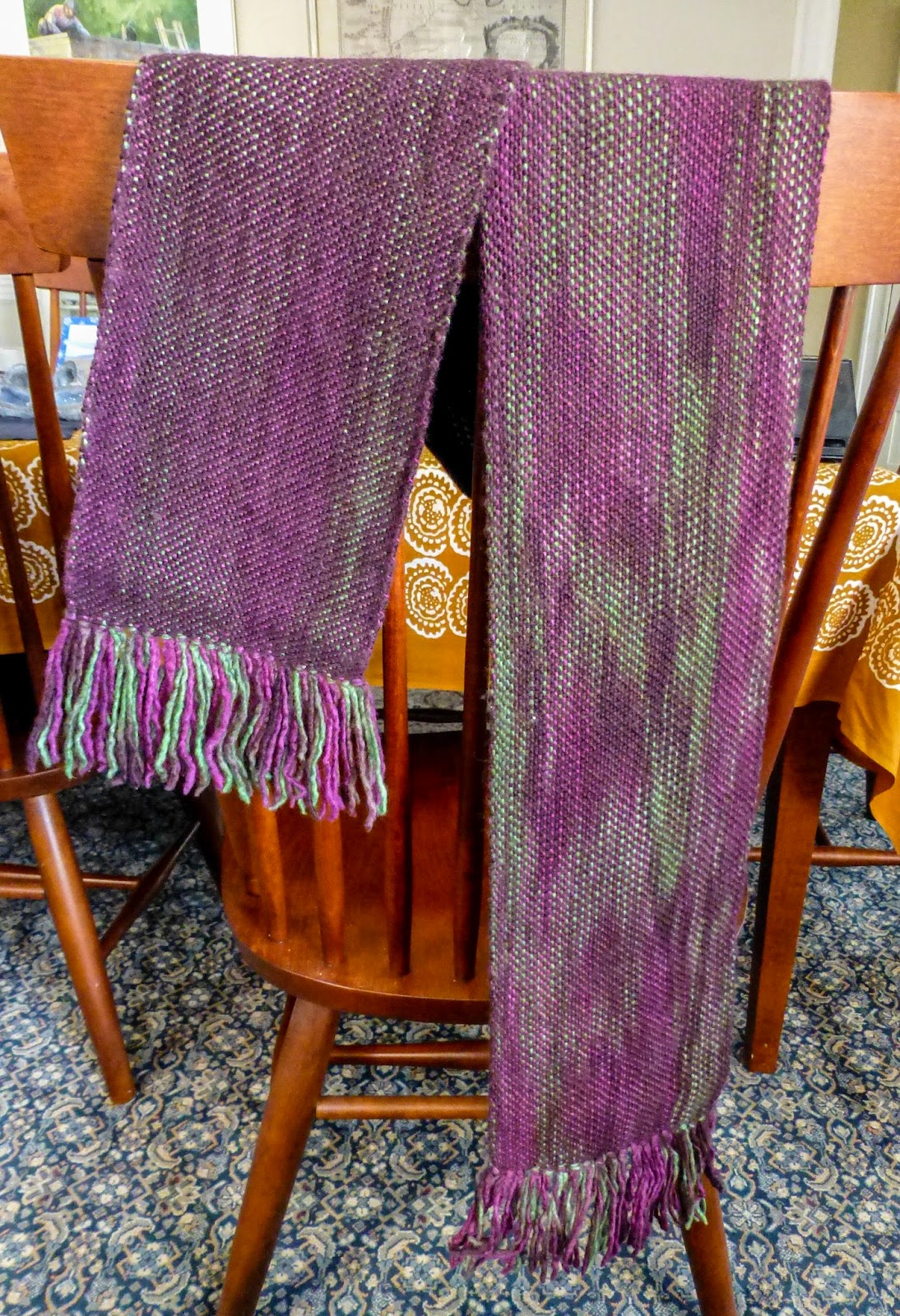
I bought the yarn in a very nice yarn shop in Montpelier, VT called The Knitting Studio (which truly might be "Vermont's friendliest yarn shop.") The warp is one skein of Malabrigo worsted in color #239 (Saphire [sic] Magenta) and the weft is Cascade 220 worsted wool in color #2403 (Chocolate).

The Malabrigo is 100% merino wool and a relatively bulky gauge for weaving, so it turned out to be a little bit stiff and heavy for a scarf, but the colors are really beautiful. Again, my pictures don't do it justice; the green and magenta highlights in the warp look like jewels in the sunlight.

Wrong side on left,
right side on right
I also like the contrast between the weave design
and the color: the tweed is almost a mechanical, digital pattern, but the variegation in the yarn is organic and flowing.

Tweed Detail


Monday, April 20, 2015

Navy Variegated Tweed Scarf

Completed: 2014
Dimensions: 5 1/2" wide by 62" long (with 3" fringe at each end)

The finished scarf
I went to the Vermont Sheep and Wool Festival in 2013 and in the Fiber Stash stall I found a skein of a hand-dyed alpaca blend in variegated blues that I thought was one of the loveliest combinations of colors I had ever seen. Having forgotten to bring any cash, I had to borrow money from a friend to buy the skein.

Tweed pattern detail
I used the skein as the warp for a scarf, and used one skein of worsted-weight Malabrigo Arroyo in Prussian Blue as the weft, since it matched one of the colors in the variegated alpaca.

I made my scarf on a rigid heddle loom using two 10-dent heddles. I warped the loom for a three-shaft tweed (1-2-3 repeat), and wove it in a two-up, one-down staggered tweed pattern.

It turned out to be a lovely scarf, and the Malbrigo went perfectly with the hand-dyed yarn. Because I used the two-up, one-down tweed, one side is dominated by the Malbrigo blue and the other side is dominated by the hand-dyed yarn, but I think that makes for a nice effect when it's wound around somebody's neck. The pictures here show the warp pattern, but definitely do not do the colors justice.

The scarf in action


Monday, March 9, 2015

Shetland Tweed Sampler Scarf

Completed: Spring 2014
Finished Size: 6" wide by 57" long (plus 3" fringe at each end)

Finished scarf under observation
I have just gotten into weaving relatively recently. I took a beginner's weaving class at the 2013 Vermont Sheep & Wool Festival, and we all got to keep the small (14" x 14") frame looms we used in the class. After playing with that for a couple months, it was so much fun that I bought a small (16") rigid heddle loom.

Of course, because I like to make everything more complicated, eventually plain weave wasn't enough and pick-up sticks were too labor-intensive for the designs I wanted to do. So I bought two more heddles and the book Weaving with Three Rigid Heddles by David B. McKinney, so I could make three- and four-harness tweed patterns on my rigid heddle loom.

This scarf is my first attempt to do a real garment this way. 

The pattern is a pretty basic diamond tweed repeat using four harnesses (or, in my case, three heddles).

The warp is two balls of Jamieson Shetland Spindrift in mooskit. There are 72 ends (including 2 selvedge ends) and I used three 10-dent reeds.
The diamond tweed pattern

The weft is a random collection of six balls of Jamieson Shetland DK (in grouse, moorland, pine, osprey, willow, and sage) I had lying around for years after finishing a fair isle vest. I figured this would be a good way of using them up. Not all of them were used in the vest, and I wasn't sure how they were going to go together, but, hey, it's a sampler. This is the color repeat I used:

Tweed pattern detail
6 picks grouse
30 picks moorland
6 picks pine
30 picks osprey
6 picks willow
30 picks sage

I figure it is inevitable that someday I will end up with a sixteen-harness loom.


The scarf in action


Monday, February 16, 2015

Rainbow Orphan Scarf

Completed: 2014
Finished Size: 7" wide by 72" long

I made this scarf using a pattern called Orphan Scarf by Doris Chan. Her technique in this pattern is really simple; you basically just do rows of single crochet with very small gauge yarn with a very large hook. While you're working with it, it doesn't look like the spaces between the rows are very big, but once you've washed it and blocked it and stretched it out, the rows get really far apart.

She uses it in a number of patterns, including a set of curtains.

The finished product
I did have trouble with the ends, as they were firmer than the middle and tended to bow out wider than the body of the scarf. Maybe it's something about the way I cast on and finish off my crochet; or something in the blocking. If I was to use this technique again, I might not stretch it quite so far, and let it stay a bit more uniformly wide all over.

Detail of single-crochet loops
It's an excellent pattern if you want to try something with just one skein of laceweight yarn, which is what I had: a skein of about 400 yards of rainbow hand-dyed merino lace yarn I had bought at the Ann Arbor Art Fair in 2013.

Monday, January 26, 2015

Diamond-Motif Scarf with Yarn from the Kangaroo Dyer

Completed: 2008
Finished Size: 8" wide by 62" long

Finished scarf
I crocheted this scarf using yarn I won as a door prize at the 2007 Franklin County Fiber Twist festival in Greenfield, MA. (This festival is now known as the Fiber + Fashion event at the Little E).

Detail of crochet diamond motif
The yarn had no label on it, so I'm not sure what type of wool it was or how much of it I had or where it came from, but I think it is a merino sock yarn, and I'm guessing it was about 400 yards. I wasn't sure I'd have enough yarn to finish the scarf, but it turned out to be more than enough.

I do know it was hand-dyed by the Kangaroo Dyer, and that my photos on this page don't do it justice; it is really a nice variegated combination of autumnal colors, from ochre to burgundy to black.

I used a crochet pattern from Jojoland called simply "Cashmere Scarf," which doesn't really do the pattern justice either; it is a good-looking, well-proportioned, lacy but sturdy pattern of interlocking diamonds. I kept it for myself and it's been one of my totally unreproducible favorites for years.

Monday, January 5, 2015

Steamer Trunk Baby Henley Pullover

Completed: October 2014
Finished Size: fits a 0-to-6-month-old baby

Working a sweater from the top down
feels awkward at first.
I knitted this using Erica Kempf Broughton's Simple Baby Pullover pattern, which is a free pattern you can download from Ravelry.com.

It is a top-down pattern, and I'd never worked a sweater from the top down before, and I didn't have the right length #7 circular needle so the needle I made it on was enormously long, so it felt a little bit awkward while it was in progress, but it was interesting to see how it came together.

The finished product
The pattern is written for a Cascade Yarns worsted yarn, but, on the advice of Webs Yarn Store, I used Mrs. Crosby's Steamer Trunk yarn as a direct substitute with no change in gauge.

The sweater knits up very quickly with such a big yarn, and the roasted chestnut color I used had really nice color variegation. I had originally planned to put black buttons on the placket, but after seeing the color in person, I decided red would be better (not to mention more fun).

The superwash merino is also machine washable and dryable, which should certainly be a plus in a baby sweater.